|
Thirty years after Serbian forces massacred over
8000 people at Srebrenica, Serbia’s current leaders continue to deny
any collective responsibility for the genocide, blocking the road to
reconciliation, and vividly showing how the ethno-nationalist
mentality that produced the atrocity still dominates the society,
and prevents it from moving forward.
Serbia is experiencing a profound political
crisis. In the face of widespread protests, the regime’s resort to
violence, blackmail, defamation, and accusations of a “color
revolution” funded by the West have placed the country in a de facto
state of emergency. The situation is becoming increasingly complex,
and the toxic atmosphere—marked by a rise in violent incidents,
arrests, blackmail, salary cuts for those who support the students,
and agitprop media campaigns—is widening the gap between the
government and a large part of the citizenry.
For over eight months, massive numbers of students
and others have regularly demonstrated on the streets of Serbian
cities, demanding political and institutional reforms by the
government lead by President Aleksander Vučić, who has ruled Serbia
for 12 years. On 28 June, when each year Serbs celebrate, as many as
140,000 peaceful protesters demanded snap elections. The demand has
been flatly rejected by Vučić, which is no surprise given his
sinking popularity. The government has made no constructive
response, but has claimed a coup is planned, and has arrested
alleged leaders. Mr. Vučić has built a network of so-called
loyalists who, he recently claimed, “swore in blood” to serve him.
Vučić is relying on this group as he moves against the rectors,
professors, students, independent journalists and intellectuals who
have joined the protest movement. As university occupations and
student-organized assemblies have continued, he has frontally
attacked Serbia’s educators and academic community. Including
threats of firings, the withholding of salaries and the beating of
students, it amounts to a wholesale assault on universities.
Popular frustration is rising along with the
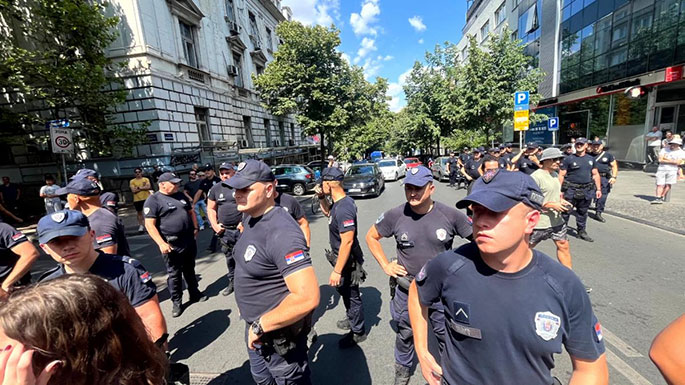
demonization of peaceful demonstrators and violent police
repression. According to Amnesty International, “There have been
widespread arrests and allegations of excessive or otherwise
unlawful use of force against student protesters – during the
protests, the arrests and in police custody. Authorities must
urgently investigate and explain reports of masked individuals in
civilian clothes targeting protesters.” Students and their allies in
civil society want to leave the country’s aggressive
ethno-nationalism in the past, and seek a new, liberal, path for the
country. For this they are called traitors.
National European and European Union leaders have
generally seen Vučić as a force for “stability” in Serbia and the
Balkans, despite increasing corruption and his regressive approach
to the independence of Kosovo and the territorial integrity of
Bosnia-Herzegovina, which has made him a kind of Milosevic-lite. But
to offset reactions, he is also something of a Tito-lite, keeping
European leaders off balance. He has skillfully navigated a twisted
course among Russia, China, the EU (especially Germany), and the US.
However, the war in Ukraine and the new administration in Washington
have narrowed the space for his usual balancing act.
In this situation, European leaders have been
largely silent, but without assistance to help resolve the impasse,
Serbia is likely to degenerate into an authoritarian police state
that will give Russia and China a stronger foothold in Southeastern
Europe, which will threaten European security, potentially opening
up a second assault on Europe from the south. Indeed, with the
erosion of Vučić’s popularity and legitimacy in the face of the
protesters’ sincere demands, he could well precipitate a foreign
policy crisis to divert public attention, stoke nationalism, and
give cover for harsher domestic policies and crackdowns on
fundamental rights and freedoms. Kosovo and Bosna Herzegovina
provide ample opportunities.
Serbia is a candidate for membership in the
European Union, yet public opinion surveys have shown that only a
small minority of citizens think the country has a realistic chance
of actually joining the EU, while many more see Russia as Serbia’s
more likely long-term partner, which reflects the saturation of
Russian propaganda in the Serbian media space. Vladimir Putin is the
most popular foreign politician in Serbia.
The visible decline in public support for Serbia’s
EU membership is clearly a product of government-controlled media
and propaganda machines, as well as the regime’s concrete moves and
ambivalent stance toward the EU. But lukewarm reactions from some EU
officials and leaders at the start of the student protests have
undermined citizens’ trust in Brussels, since many believe the EU
still supports Vučić. This is also attributed to various promises
Vučić made to them, including lithium mining, which has been listed
among the 17 strategic EU projects outside the Union.
Students have succeeded in awakening a society
that has for decades been exposed to destructive forms of
nationalism and populism. To channel the energy of both the students
and local communities—and to prevent civil unrest—the EU should
initiate a genuine process toward Serbia’s accession. And the EU
should reach out to the people and government of Serbia through a
special envoy and an offer to mediate in the current crisis, which
threatens broader European security.
Sonja Biserko is President of the Helsinki
Committee for Human Rights in Serbia. Aaron Rhodes is the former
Executive Director of the International Helsinki Federation for
Human Rights, and was also president of the Forum for Religious
Freedom Europe.
|