|
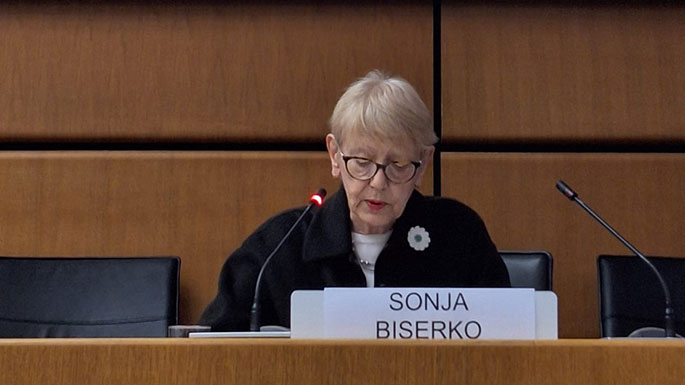
Ladies and gentlemen,
As we commemorate the 30th anniversary of the genocide in
Srebrenica, we do more than honor the victims. We are called to
defend the truth.
The UN Resolution on Srebrenica, adopted in 2024, reminded the world
of the legal and moral clarity surrounding this crime. It named what
happened — genocide. And it urged all societies, especially those in
the region, to confront that truth with courage, not denial.
In today's world, where ethnonationalist rhetoric and authoritarian
rule are on the rise, memory becomes a warning. A warning against
scapegoating. A warning against exclusion.
Genocide remembrance gives us a framework. It helps us understand
and respond to mass atrocities today — whether in Gaza, Myanmar,
Sudan, or Ukraine. It compels international actors to act. Not to
stand aside.
Remembering genocide is not a backward-looking act—it is a
profoundly forward-looking responsibility. In today’s unstable
international environment, where power politics often trumps
principles, remembrance becomes a form of resistance, a defense of
truth, and a call to uphold the values of humanity.
Yet, three decades later, we face a harsh reality. Serbia not only
denies the genocide — it continues to justify and politically
reproduce the very ideology that made it possible.
Denial in Serbia does not stop with political leaders. It is
embedded in academic institutions, in the media, in intellectual
circles, and in the church.
Serbian elites — writers, professors, historians, clergy — continue
to promote the idea of a “Serb world.” This is nothing less than a
euphemism for the old Greater Serbia project. A project pursued
through war crimes, ethnic cleansing, and ultimately, genocide.
The “Serb world” is not merely a cultural aspiration. It is a
geopolitical ambition. It is built on the erasure of non-Serb
communities from territories claimed as “historically Serb.”
Srebrenica was the most brutal expression of that logic. The killing
of over 8,000 Bosniak men and boys was meant to ensure that a future
Republika Srpska would be ethnically pure, safe zone free.
In that sense, the ongoing secessionist policy of Republika Srpska
is not new. It is not separate. It is the political finalization of
the genocide.
It aims to legitimize the territorial outcome of ethnic cleansing.
To cement the results of violence. To institutionalize apartheid
through laws, symbols, and a false narrative of victimhood.
By denying genocide while glorifying its perpetrators — Ratko Mladić
and Radovan Karadžić — Serbia insults the memory of the victims. But
more than that, it sustains the ideological infrastructure that made
the genocide possible.
This is not only dangerous for Bosnia and Herzegovina. It is
dangerous for the region. It undermines the credibility of
international law.
In the spirit of the UN Resolution on Srebrenica, we must state
clearly:
There can be no reconciliation without truth.
There can be no peace while war criminals are celebrated.
And there can be no stability if the results of genocide are
normalized through secession.
The international community must not allow Republika Srpska’s push
for independence to go unchallenged. To allow it would be to reward
genocide. It would permanently fracture Bosnia and Herzegovina.
It would send a dangerous message to the world: that crimes against
humanity can succeed, if pursued with enough persistence.
In the spirit of the UN Resolution on Srebrenica, we must insist:
Serbia must confront its past honestly.
This means acknowledging the genocide. But it also means dismantling
state-sponsored narratives that glorify its perpetrators.
It means introducing genocide education into school curricula.
Removing war criminals from the pantheon of national “heroes.”
Supporting civil society actors who courageously speak the truth.
Meanwhile, civil society in Serbia — along with the brave
individuals who stand against denial — must be supported.
They are few. Often silenced. But they are the future.
They hold the key to an honest reckoning. And to a Serbia that can
one day return to Europe. Not as a revisionist force, but as a
democratic partner rooted in truth and accountability.
True reconciliation begins with truth. Without it, peace remains
superficial. A fragile pause, not a durable foundation.
However, Serbia has repeatedly demonstrated a lack of political will
and institutional capacity to confront its own past. Instead of
fostering accountability and reconciliation, the political elite
continues to engage in historical revisionism, the glorification of
war criminals, and the denial of atrocities such as the Srebrenica
genocide.
In this context, the role of the European Union and the Council of
Europe is not only important—it is irreplaceable. These institutions
hold a unique responsibility and capacity to shape the normative and
institutional frameworks that Serbia has so far failed to establish
on its own.
In the spheres of education, culture, and media, their involvement
is crucial.
By reinforcing these three pillars, the EU and the Council of Europe
can help lay the foundation for a democratic and self-reflective
Serbian society. This is essential not only for Serbia’s own future,
but also for the stability and democratic integrity of the wider
region.
Srebrenica is not only a place of mourning — it is a call to action
for all international organizations and institutions whose mandate
is to uphold fundamental human rights and freedoms.
In commemorating the genocide in Srebrenica, they confront one of
the greatest challenges of the post-1995 world: the imperative to
prevent further descent into human rights atrocities and genocidal
violence. These horrors, as we are painfully aware — and as the UN
Secretary-General has described — are "beyond atrocious, beyond
inhuman."
So far, we have failed to truly "learn the lessons" of Srebrenica.
Let us hope it is not too late.
Thank you. |